The Phycosphere—Aladdin's Lamp for Saving the Oceans
SCBE publishes article on the phycosphere in Trends in Microbiology
The ocean covers more than 70% of the Earth's surface area and is the source of human life. The market value of marine and coastal resources and industries reaches $3 trillion annually, accounting for approximately 5% of global GDP, and the livelihoods of over 3 billion people depend on marine and coastal biodiversity. However, the global marine situation is grim, with problems such as environmental pollution, climate change, and marine debris occurring frequently, restricting the sustainable development of human society and the ocean. Ocean health is critical to the destiny of humanity.
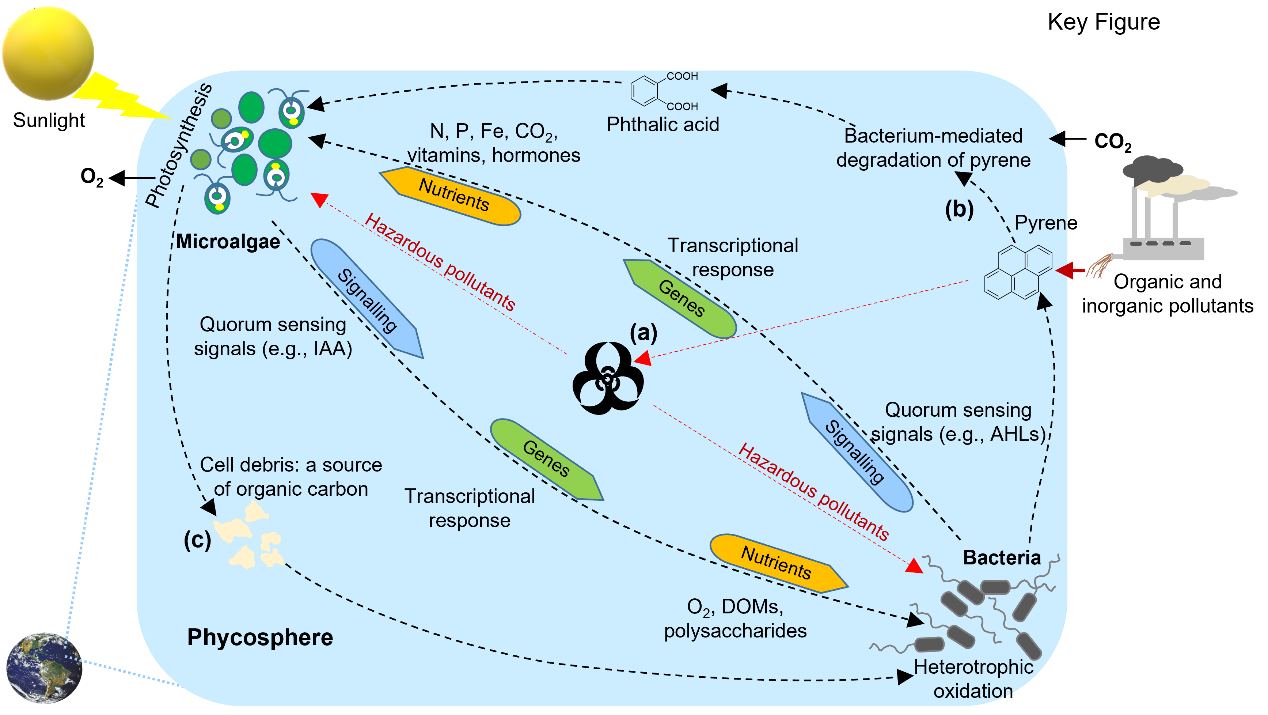
Microalgae are the most important primary producers in the marine ecosystem. Through photosynthesis, they efficiently convert carbon dioxide into organic matter, contributing more than 40% of global organic carbon and playing a key role in the global carbon cycle. Microalgae are not alone in the water. A range of microorganisms live around microalgae and inside their cells, collectively known as the microbiome, of which bacteria are by far the most numerous members. The phycosphere is formed by microalgae and their associated microbiome. The phycosphere constantly adapts to the changing water environment, responding to and remediating increasingly severe marine pollution. The phycosphere is closely linked to ocean health, jointly building a community with a shared future. Therefore, gaining a deep understanding of the interaction mechanisms of phycosphere microorganisms and elucidating the interactions between algae and bacteria during the remediation of polluted water bodies not only has significant scientific importance but also holds practical significance for constructing a harmonious and healthy marine ecological environment.
Recently, Trends in Microbiology published an online paper by SCBE titled "Synergy between microalgae and microbiome in polluted waters" (https://doi.org/10.1016/j.tim.2022.06.004). Focusing on the latest progress in algae-microbiome research in polluted water environments, the article points out that the phycosphere can be considered an independent life form (like the human body and its associated microbiome). When exposed to a polluted environment, algae and bacteria collaborate to defend against external threats; they regulate life processes and alter genomic composition through nutrient exchange, extracellular polymeric substance secretion, signal molecule transduction regulation, and horizontal gene transfer to achieve short-term, medium-term, or long-term adaptation. At the same time, the phycosphere can also be considered a collection of life forms. When facing external enemies, they constantly adjust their relationships—whether parasitic, symbiotic/commensal, or antagonistic/competitive—and alter community structure to adapt to the changeable water environment.
The article also proposes the concept of the "PollutantBiome" to help understand microalgae-microbiome interactions and develop beneficial synthetic microbial communities for pollutant remediation. Finally, the article points out that artificially designed, sophisticated microalgae-microbiome symbionts are expected to become "Aladdin's Lamp" for saving the ailing oceans, revitalizing the oceans, and achieving harmonious development between humanity and the ocean.
Postdoctoral fellows Noreen Ashraf and Fiaz Ahmad are the first authors of the paper. This research was supported by the Ministry of Science and Technology, the National Natural Science Foundation of China, the China Postdoctoral Science Foundation, and the Hainan Provincial Postdoctoral Innovation Program.
Article Link:
https://www.cell.com/trends/microbiology/fulltext/S0966-842X(22)00160-3
SCBE is committed to (1) elucidation and regulation of metabolic pathways in single-cell organisms; (2) development of synthetic biology technologies using microalgae as chassis; (3) interaction mechanisms between single-cell organisms and the environment, and remediation technologies. In recent years, the team has undertaken special projects, topics, and sub-topics of the National Key R&D Program, key projects for innovative development of the marine economy under the National 13th Five-Year Plan, projects from the National Natural Science Foundation of China, special projects for the construction of the operation service system of the China National Intellectual Property Administration, and the China Postdoctoral Science Foundation. Due to project needs, the team is sincerely recruiting researchers and outstanding postdoctoral fellows from home and abroad.
For details, please visit: http://www.scbioengineering.com/recruit