Mid-chain Triacylglycerides (MCTs) are a special type of functional oil clinically used primarily for weight loss, promoting energy metabolism, and aiding recovery in individuals with neurodegenerative conditions. Recently, the Single-Cell Center at QIBEBT, in collaboration with the High-Resolution Separation Analysis and Metabolomics Group at DICP, revealed the molecular mechanisms regulating MCT synthesis in microalgal cells. Subsequently, they developed an industrial oleaginous microalgal cell factory with high MCT yield. This achievement was published online in Plant Physiology.
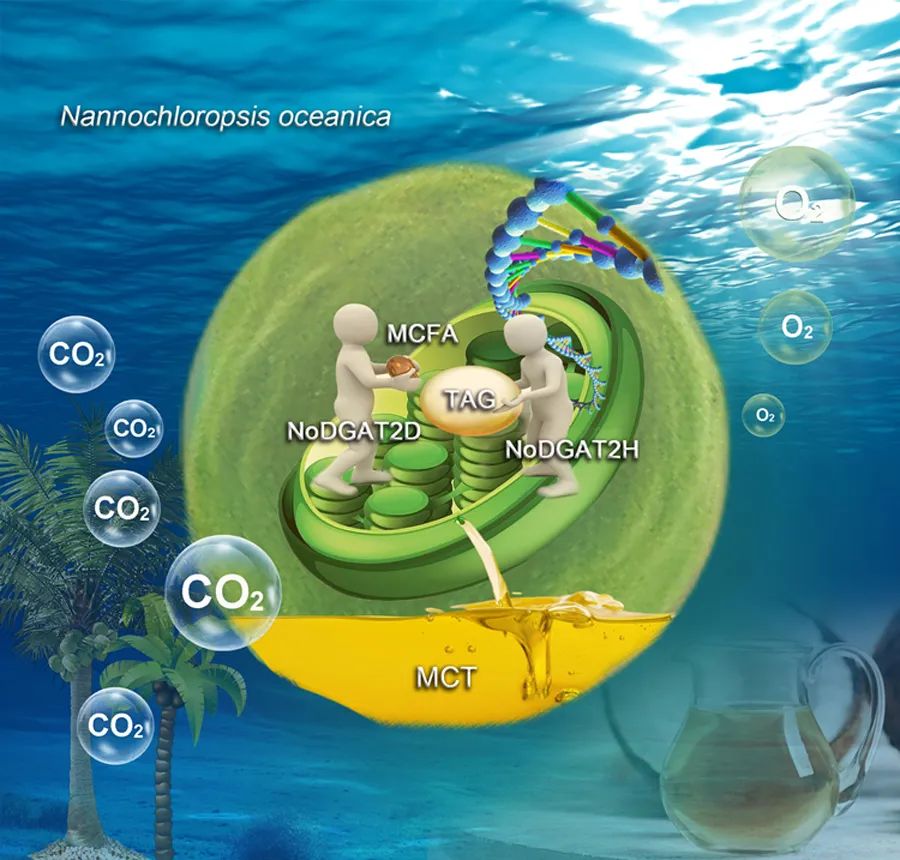
MCTs refer to triglycerides containing three mid-chain fatty acids (MCFAs, consisting of 8 to 12 carbon atoms). MCTs can be completely absorbed into the intestinal mucosa cells without the need for bile salts and enter the liver directly via the portal vein in the form of fatty acids. Therefore, MCTs can provide rapid energy to the body without accumulating as fat, offering significant health benefits.
Currently, MCTs are produced through the hydrolysis, filtration, and re-esterification of palm oil or coconut oil. However, oil palms and coconuts can only be grown in tropical and subtropical regions, and typically, plants store only about 3% of their dry weight as oil. Consequently, the industry urgently needs more efficient and environmentally friendly methods for MCT production.
Nannochloropsis spp. is an industrial oleaginous microalga capable of directly converting sunlight, seawater, and carbon dioxide into triacylglycerides (TAGs), which contain over 20 types of fatty acids. Is it possible to "custom-design" the chain length of fatty acids on TAGs to achieve MCT synthesis using Nannochloropsis? A research group led by Associate Professor Xin Yi from the Single-Cell Center, together with Assistant Professor Wang Qintao, Assistant Professor Shen Chen, and Associate Professor Hu Chunxiu from DICP, utilized MCFA-mediated heterologous expression in yeast and in vitro enzymatic assays. They discovered that only two type II diacylglycerol acyltransferases (NoDGAT2) in Nannochloropsis are capable of assembling MCFAs into MCTs. Among them, NoDGAT2D acts as a "generalist" technician, capable of assembling fatty acids of various chain lengths from C8 to C18, while NoDGAT2H acts as a "specialist" technician, specifically assembling C8 and C12 MCFAs. Subcellular localization experiments further confirmed that both DGAT2s participate in TAG assembly within the chloroplast.
Furthermore, the researchers rationally regulated the transcriptional levels of these two DGAT2s in Nannochloropsis and combined this with the expression of multiple other exogenous MCT synthesis enzymes to construct an engineered algal strain with high MCT production. During the peak oil production phase, the MCT content of the engineered strain increased by 64.8 times compared to the wild type.
The saturation and chain length of fatty acids in TAGs are two key indicators determining the economic value of algal oil. Previously, the Single-Cell Center team revealed the mechanisms by which Nannochloropsis regulates fatty acid saturation in TAGs (Xin, et al., Mol Plant, 2017; Xin, et al., Mol Plant, 2019). This work further elucidates the mechanism by which the alga regulates fatty acid chain length in TAGs. On this basis, it has become possible to use industrial microalgae as a chassis to produce oil molecules with customizable structures, laying the foundation for the one-step biosynthesis of various fuel and edible oil products with special properties from CO2.
This work was completed in collaboration between the team of Professor Xu Jian at the Single-Cell Center of QIBEBT and the team of Professor Xu Guowang at the High-Resolution Separation Analysis and Metabolomics Group of DICP. It was supported by the National Key R&D Program of China, the DICP-QIBEBT Convergence Fund, the National Natural Science Foundation of China, and the Natural Science Foundation of Shandong Province. (Text/Xin Yi, Image/Liu Yang)
Link to original article: https://doi.org/10.1093/plphys/kiac396
Yi Xin#,, Qintao Wang#, Chen Shen#, Chunxiu Hu, Xianzhe Shi, Nana Lv, Xuefeng Du, Guowang Xu, Jian Xu*. Medium-chain triglyceride production in Nannochloropsis via a fatty acid chain length discriminating mechanism. Plant Physiology, 2022.