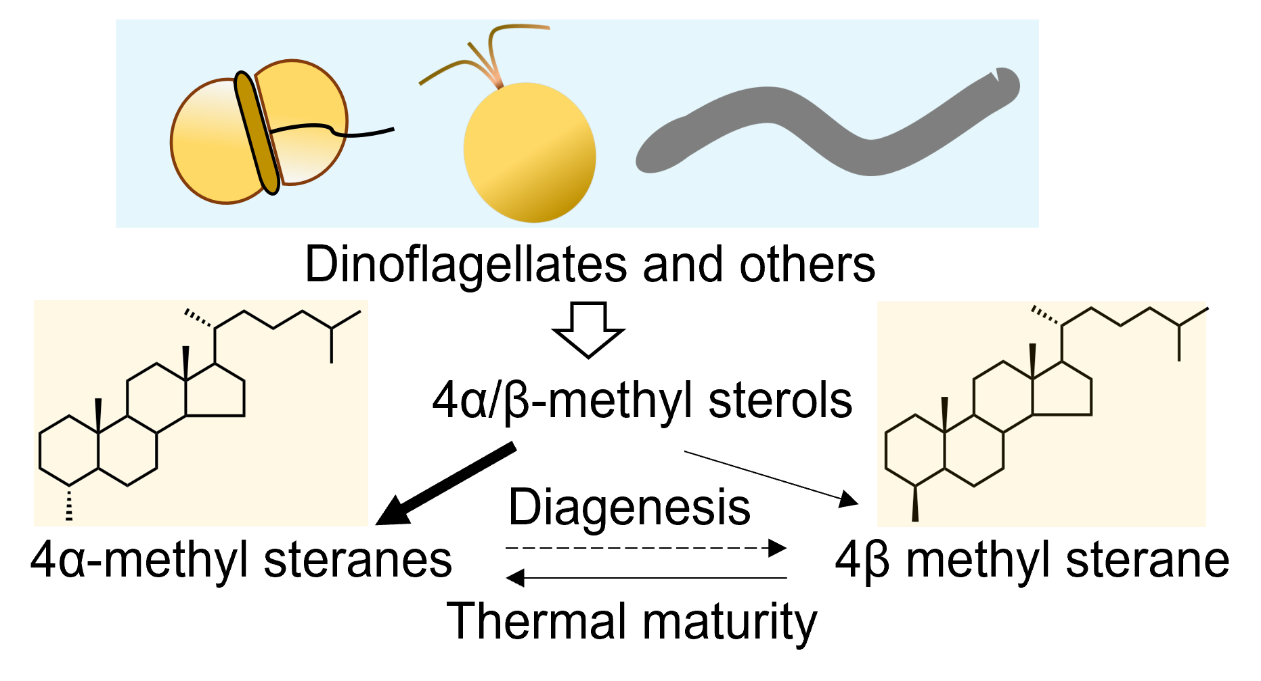
Crude oil is the blood of national industry. Biogeology is an important means of predicting the existence of underground oil and gas reservoirs. Changes in the abundance of C4-methylsteranes in rock formations are widely used in the study of biological evolution and geological history. The biological origin of its isomeric form, C4α-methylsterane, has reached an affirmative consensus in the industry, but its biosynthetic pathway has never been experimentally verified. However, the origin of its isomeric form, C4β-methylsterane, has always been controversial; almost no biological source of it has been found in nature. For a long time, C4β-methylsteranes were thought to be formed from C4α-methylsterols during diagenesis, and the ratio of C4α- to C4β-methylsteranes was used as an important indicator of sediment maturity for crude oil and natural gas exploration. Simply put, the older the rock formation, the higher its C4α/β ratio, the higher the maturity of the rock formation, and the more likely it is to form crude oil. Therefore, the elucidation of the biosynthetic mechanism of C4-methylsterols has important theoretical significance and practical value.
Zooxanthellae are one of the species with the most abundant fossil evidence. The symbiotic relationship between them and host corals can be traced back from the Middle Ordovician to the Late Permian (450 – 251 Ma). Zooxanthellae provide a large amount of continuous fossil evidence for biological evolution and geological research on temporal and spatial scales. Recently, the team led by Lu Yandu from the College of Marine Sciences of our university and the State Key Laboratory of Marine Resource Utilization in South China Sea discovered a new biosynthetic mechanism capable of co-synthesizing C4α- and C4β-methylsterols in coral symbiotic zooxanthellae. They also proved that this mechanism exists widely in globally distributed plankton such as alveolates (e.g., zooxanthellae) and haptophytes (e.g., chrysophytes), which play an important influence in marine biogeochemical processes. This discovery revises the classic model of the origin of C4α- and C4β-methylsteranes, will further improve the calculation method of sediment maturity indicators, and provides new theoretical support for explaining geological history and crude oil exploration. This work was published online in the Journal of the American Chemical Society on May 13.
This research was supported by the National Key R&D Program (2021YFA0909600, 2021YFE0110100), the National Natural Science Foundation of China (32060061, 3120006), the Hainan Provincial Key R&D Program (ZDYF2022XDNY140), and the Open Project of the State Key Laboratory of Marine Resource Utilization in South China Sea (MRUKF2021003). Associate Professor Zhou Wenxu of the State Key Laboratory is the first author, and master's students Zhang Xu (2019 cohort), Wang Aoqi (2020 cohort), and Yang Lin participated in this work. Hainan University is the first unit, and the work was completed in collaboration with the Department of Earth, Atmospheric and Planetary Sciences at MIT, USA, the CSIRO Oceans and Atmosphere in Australia, and the State Key Laboratory of Marine Geology at Tongji University, with support from Deputy Dean Yi Liang of the School of Ocean and Earth Science at Tongji University.
Article Link: https://pubs.acs.org/doi/10.1021/jacs.2c01401
Hainan University is a key university under the national "211 Project", a "Ministry-Province Jointly Constructed University" by the Ministry of Education and the Hainan Provincial Government, and a national "World-Class Discipline Construction University". In 2018, the Hainan Provincial Government Work Report clearly proposed to "support Hainan University with the strength of the whole province": Hainan University was selected as a "Ministry-Province Jointly Constructed" university and included in the ranking of universities directly under the Ministry of Education. With the advancement of major projects such as the National Free Trade Port and the National Ecological Civilization Pilot Zone (Hainan), Hainan University has ushered in new historical opportunities. The State Key Laboratory of Marine Resource Utilization in South China Sea is the first State Key Laboratory in Hainan Province established with the approval of the Ministry of Science and Technology in August 2016, and is one of the eight State Key Laboratories in the marine field (as of 2020). Zhang Si, Academician of the Chinese Academy of Engineering, and Dai Minhan, Academician of the Chinese Academy of Sciences, served as members of the first Academic Committee. Relying on Hainan University, the only national first-class discipline construction university in the province, the laboratory serves China's maritime power strategy and Hainan's local economic development.
The Marine Single-Cell BioEngineering Team is dedicated to (1) analysis and regulation of metabolic pathways in single-cell organisms; (2) development of synthetic biology technologies using microalgae as chassis; (3) interaction mechanisms between single-cell organisms and the environment and remediation technologies. In recent years, it has undertaken special topics and projects of the National Key R&D Program, key projects of the National 13th Five-Year Plan for Marine Economic Innovation and Development, the National Natural Science Foundation of China, special projects for the construction of the intellectual property operation service system of the National Intellectual Property Administration, and the China Postdoctoral Fund. Results have been published in Nature Comm, Advanced Science, etc. Due to research needs, the team sincerely recruits lecturers and excellent postdoctoral researchers from home and abroad.
For details, please visit: http://www.scbioengineering.com/recruit